




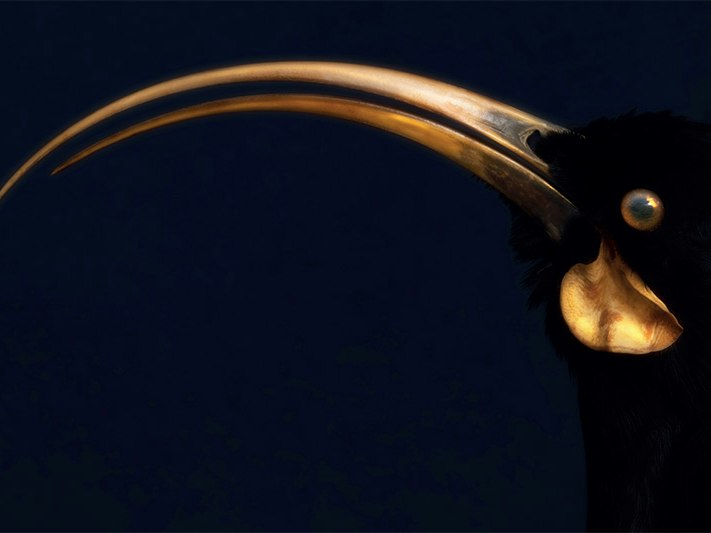
Meet the manu in Taharaki Skyside
Learn more about the native manu behind Fiona Pardington’s Taharaki Skyside. Each is unique, culturally and environmentally important, and many need our protection.
Free museum entry for New Zealanders and people living in New Zealand
Open every day 10am-6pm
(except Christmas Day)
Free museum entry for New Zealanders and people living in New Zealand
Three huia (Heteralocha acutirostris), circa 1900, London, by Johannes Keulemans. Purchased 1993 with New Zealand Lottery Grants Board funds. Te Papa (1993-0029-6)
Some human imitation calls available on NZ Birds Online.
Remains indicate that the huia were found in forested mountain ranges of the North Island.
Huia are Extinct.
The last confirmed sighting was in 1907, but a few birds probably survived into the 1920s. The huia was driven to extinction by introduced predators, hunting, and habitat loss.
Huia were sexually dimorphic; the females had a long, slender curved beak, and the male a shorter, thicker one. Paired birds used these different tools to maximise the food available to them. Males would tear away the outer bark of a sapling so that the female could try to extract insects and larvae from their holes. If necessary, the male would enlarge the hole to assist her in her task.
It was reported by the early naturalist Walter Buller that partnered male and female huia would gently caress one another with their beaks, “uttering at the same time a low affectionate twitter”.
He huia tangata tahi
There is but one person synonymous with the huia
This The whakataukī speaks to how sacred the huia was in te ao Māori, so important and treasured as to be compared to a chief.
In te ao Māori, huia feathers were the mark of high status. You could wear huia feathers in your hair, or whole skins in your ear, only if you were of chiefly rank. The huia’s name became associated with treasured things: containers for precious items were called waka huia.
Learn more about the native manu behind Fiona Pardington’s Taharaki Skyside. Each is unique, culturally and environmentally important, and many need our protection.
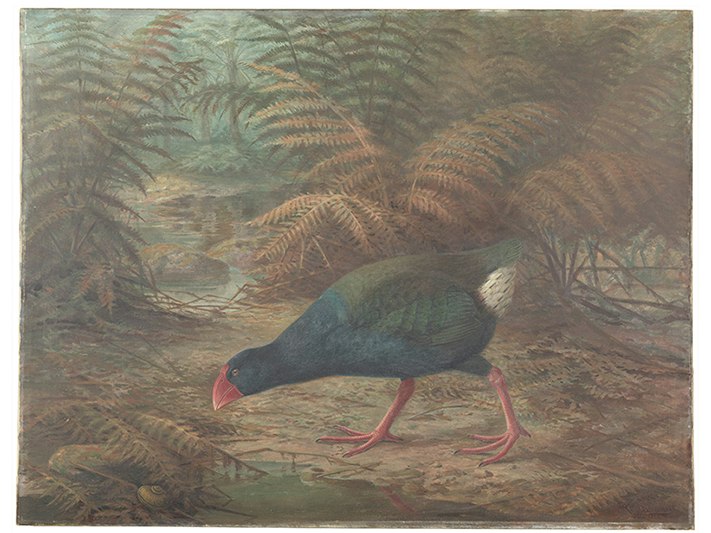
Learn about both the North Island and South Island takahē from its eggs, through to specimen collections, and bones, including a famous 1851 skin originally sent to Britain and later returned to Aotearoa New Zealand. Alongside the birds, you’ll also find watercolours, historic photographs, slides, and sketches documenting both before and after the dramatic rediscovery of the South Island takahē in 1948.
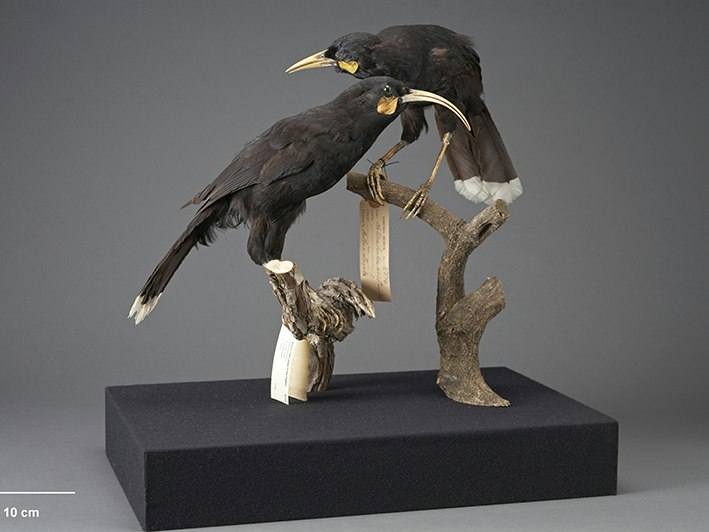
The iconic huia was the largest of the five New Zealand wattlebird species. It was a striking large songbird, mainly black with long white-tipped tail feathers, and female and male huia had dramatically different bill sizes and shapes.
This link will take you to NZ Birds Online website.