




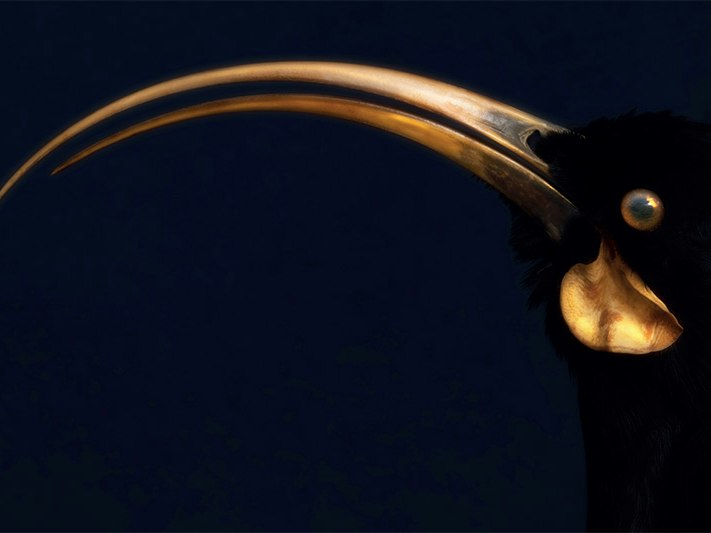
Meet the manu in Taharaki Skyside
Learn more about the native manu behind Fiona Pardington’s Taharaki Skyside. Each is unique, culturally and environmentally important, and many need our protection.
Free museum entry for New Zealanders and people living in New Zealand
Open every day 10am-6pm
(except Christmas Day)
Free museum entry for New Zealanders and people living in New Zealand
Whēkau or laughing owl (Ninox albifacies). Wright, Henry Charles Clarke, 1844-1936: Negatives. Ref: 1/1-020529-G. Alexander Turnbull Library, Wellington, New Zealand. /records/22724636
Whēkau nested in holes and crevices of dry limestone cliffs, building grass nests on the ground beneath overhangs.
Extinct since around the 1930s. Driven extinct primarily due to introduced predators.
Known as the ‘laughing owl’ because of its call, described by a naturalist of its time as a “loud cry made up of a series of dismal shrieks frequently repeated.” Its different cries were variously described as being like maniacal laughter, chilling cries, yelps, and – when calling between birds – something like a ‘coo-eee’.
One whēkau nesting site in Tākaka is thought to have been used continuously by the birds for ten thousand years!
Because whēkau were particularly noisy before rainstorms they were sometimes nicknamed “rainbirds”.
The habitats where whēkau lived gave rise to the followoing kīwaha to describe steep and stony cultivation grounds
me te pari hakoke
like a whēkau cliff
Learn more about the native manu behind Fiona Pardington’s Taharaki Skyside. Each is unique, culturally and environmentally important, and many need our protection.
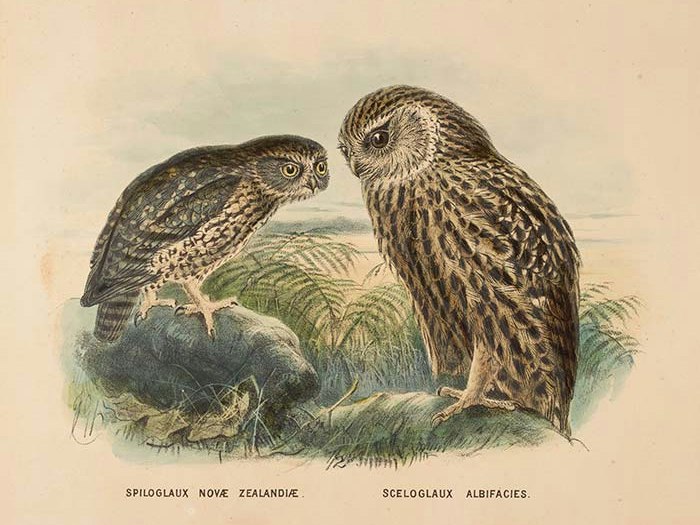
The laughing owl, or whēkau, became extinct in the early twentieth century. Their preference for dry and inaccessible roosts helped with the preservation of their remains. And although, sadly the owl no longer survives, the relics of its nest and roosting sites paint a valuable picture of the diversity and abundance of small animals and birds in prehistoric Aotearoa New Zealand.
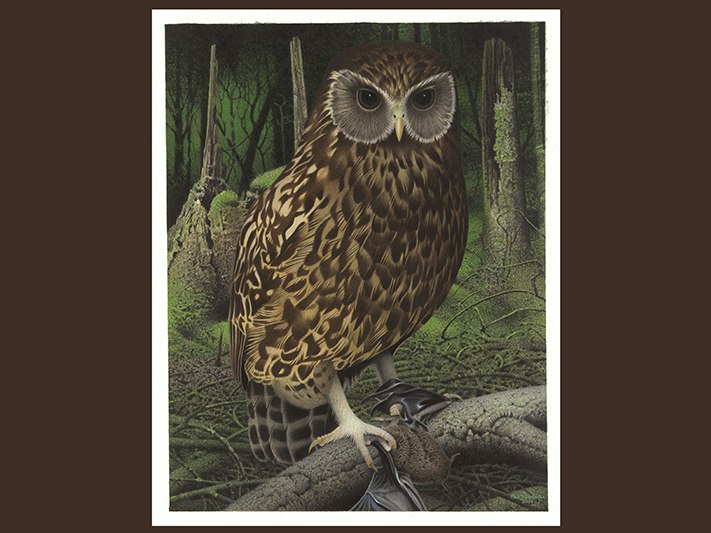
The common name of the laughing owl referred to its call, and it was a large robust dark brown owl with buff-yellow longitudinal feather patterning and yellow eyes and pale facial disks on either side of a sharply hooked yellowish bill.
This link will take you to NZ Birds Online website.