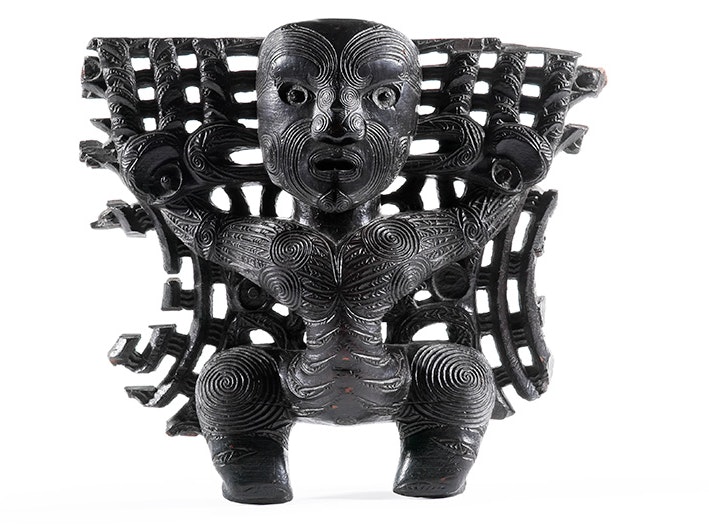
Whaka-Iro
Just as an iro – grub – eats its way through wood, the act of whakairo is also a process of bringing out or revealing the essence of something. Early ancestors drew upon the patterning created in nature for the name whakairo as the process of wood carving. As Sam says:
“The grub, it’s a pūriri grub, eh... . It bores its way through the timber. It’s not stagnant. It goes in any direction. It has a whole lot of different avenues which it goes through.”
Around the edge of the spiralled carving, different iwi from ngā hau e whā – the four winds – are represented by manaia heads who are kaitiaki enhancing the significance of what they protect.
Sam Hauwaho
Sam Hauwaho (Ngāi Tūhoe, Te Aitanga-a-Hauiti, Ngāti Awa) began learning carving in 1988 from his father-in-law, Tohunga Whakairo Rangi Hetet. As well as being a kai whakairo, Sam was also one of twelve crew members chosen for the maiden voyage of Te Aurere to Rarotonga, the first waka hourua made in Aotearoa New Zealand in modern times.
For many years he has taught carving classes to tauira at Whitireia Polytechnic, and the intergenerational aspect of Hauwaho’s practice contributes significantly to how the art of whakairo has been kept alive and flourished over time.
Watch the video
Whaka-iro (carved artwork), carved by Sam Hauwaho (Ngāi Tūhoe, Te Aitanga-a-Hauiti, Ngāti Awa), laminated tōtara, rata, pāua shell, wood stain oil. Commissioned 2025. Te Papa (ME024863)